
Molecular Properties
Computational chemistry has rapidly become a central discipline for studying chemical phenomena, as it provides accurate results at relatively low cost while avoiding the risks, expense, and environmental impact associated with many laboratory experiments. Today, electronic-structure methods are used across a wide range of fields, including chemistry, physics, and materials science, as well as interdisciplinary areas such as biochemistry, bioinorganic chemistry, drug design, and nanotechnology.
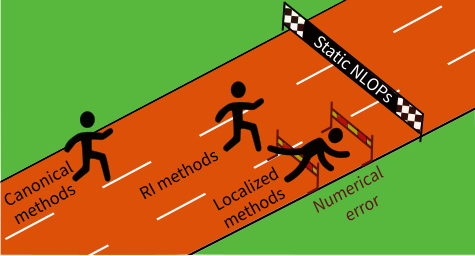
Indeed, there are well-established electronic-structure methods for computing the electronic energies involved in chemical reactions, such as activation barriers, thermodynamic reaction energies, ionization potentials, and electron affinities. However, none of these methods were explicitly designed for the calculation of molecular properties. Although they can in principle be used for this purpose, doing so has revealed a number of significant difficulties [1-6]. These findings underscore the need for a careful and systematic examination of electronic-structure methods when exploring molecular properties and the production of benchmark results that can be used for calibration [5-12].
The computation of many molecular properties entails a high computational cost and/or substantial implementation effort. Consequently, several challenges in calculating such properties have only emerged in recent years, and we anticipate that many more will arise as computational methods continue to advance —driven by increasing computational power and by the growing use of artificial intelligence and statistical learning in method development.
Our current interests focus on the development of robust methods for the calculation of molecular properties, such as first and second hyperpolarizabilities and a range of spectroscopic properties [1,7-11]. In addition, we are devoting efforts to the chemical rationalization of these molecular properties [13].
References:
1. Zaleśny R., Medved’ M., Sitkiewicz S. P., Matito E., Luis J. M.; Can density functional theory be trusted for high-order electric properties? The case of hydrogen-bonded complexes. J. Chem. Theory Comput. 15, 3570–3579 (2019).
2. Sitkiewicz S. P., Zaleśny R., Ramos-Cordoba E., Luis J. M., Matito E.; How reliable are modern density functional approximations to simulate vibrational spectroscopies? J. Phys. Chem. Lett. 13, 5963–5968 (2022).
3. Sitkiewicz S. P., Matito E., Luis J. M., Zaleśny R.; Pitfall in simulations of vibronic TD-DFT spectra: Diagnosis and assessment. Phys. Chem. Chem. Phys. 25, 30193–30197 (2023).
4. Sitkiewicz S. P., Ferradás R. R., Ramos-Cordoba E., Zaleśny R., Matito E., Luis J. M.; Spurious Oscillations Caused by Density Functional Approximations: Who is to Blame? Exchange or Correlation? J. Chem. Theory Comput. 20, 3144–3153 (2024).
5. Besalú-Sala P., Sitkiewicz S. P., Salvador P., Matito E., Luis J. M.; New Optimally-Tuned Range-Separation Density Functional for the Accurate Calculation of Electronic Second Hyperpolarizabilities. Phys. Chem. Chem. Phys. 22, 11871 (2020).
6. Fortenberry R. C., Novak C. M., Layfield J. P., Matito E., Lee T. J.; Rovibrational Quantum Chemical Analysis of c-C3H2: Overcoming the Failure of Correlation for Out-of-Plane Motions. J. Chem. Theory Comput. 14, 2155 (2018).
7. Naim C., Vangheluwe R., Ledoux-Rak B., Champagne B., Tonnelé C., Blanchard-Desce M., Matito E., Castet F.; Electric-field induced second harmonic generation of push-pull polyenic dyes: Experimental and theoretical characterizations. Phys. Chem. Chem. Phys. 25, 13978 (2023).
8. Naim C., Besalú-Sala P., Zalesny R., Luis J. M., Castet F., Matito E.; Are accelerated and Enhanced Methods Accurate to Compute Linear and Nonlinear Optical Properties? J. Chem. Theory Comput. 19, 1753 (2023).
9. Choluj M, Alam M. M., Beerepoot M. T. P., Sitkiewicz S., Matito E., Ruud K., Zalesny R.; Choosing Bad Versus Worse: Predictions of Two-photon Absorption Strengths Based on Popular Density Functional Approximations. J. Chem. Theory Comput. 18, 1046-1060 (2022).
10. Naim C., Castet F., Matito E., Impact of the Van der Waals Interactions on Structural and Nonlinear Optical Properties of Azobenzene Switches. Phys. Chem. Chem. Phys. 23, 21227 (2021).
11. Lescos L., Sitkiewicz S. P., Beaujean P., Blanchard-Desce M., Champagne B., Matito E., Castet F.; Performance of DFT Functionals for Calculating the Second-Order Nonlinear Optical Properties of Dipolar Merocyanines. Phys. Chem. Chem. Phys. 22, 16579 (2020).
12. Besalú-Sala P., Sitkiewicz S. P., Salvador P., Matito E., Luis J. M.; New Optimally-Tuned Range-Separation Density Functional for the Accurate Calculation of Electronic Second Hyperpolarizabilities. Phys. Chem. Chem. Phys. 22, 11871 (2020).
13. Sitkiewicz S. P., Rodríguez-Mayorga M., Luis J. M., Matito E.; Partition of Optical Properties into Orbital Contributions. Phys. Chem. Chem. Phys. 21, 15380 (2019).